How an aircraft carrier works - cat shots, traps and the dirty shirt mess
A Rotary Club presentation by Jim Palmquist
Jim started off by telling us that this was a backup presentation for the club to fill in for any speaker who failed to show up. It was ready when Sue Straeter was doing the program and ever since then it was not used. Well this week we had a speaker cancellation and here it is.
Jim spent almost six years in the Navy as a helicopter pilot flying off the attack carriers Kennedy, Enterprise and America, though he also was on the Roosevelt, Saratoga, Lexington, Independence, Eisenhower and the Royal Navy HMS Hermes.
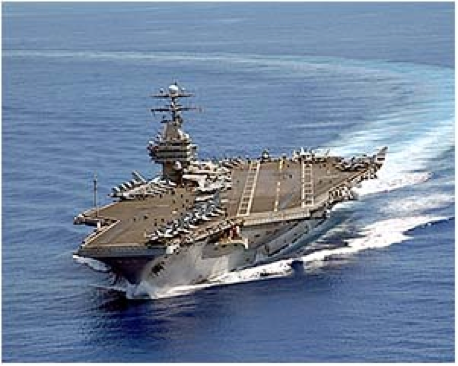
Sixty eight US aircraft carriers have existed in history; three are being built [CVN-78 Gerald R. Ford ~2015, CVN-79 John F. Kennedy ~2020 and CVN-80 Enterprise is being planned ~2025. We learned that aircraft carriers became significant naval weapons when the Japanese attacked Pearl Harbor and sank most of the Pacific fleet surface warfare ships. For the next year of the war while the US rushed to build more surface ships, the US largely fought the Japanese with aircraft and carriers.
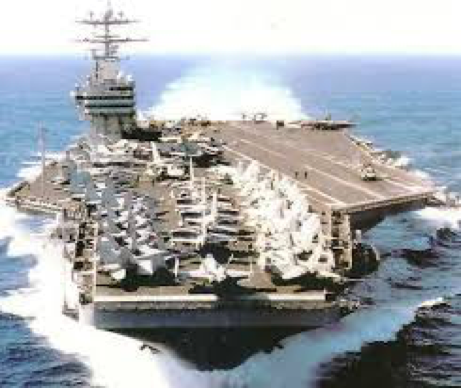
We learned the big carriers can launch aircraft from four catapults. We heard how aircraft land in the arresting area in which centerline is 15 degrees to the port side of the bow of the ship. The flight deck of these ships is 1,000 feet long and 252 feet wide.
We learned Navy terminology such as stairs are always ladders, food is served in a
mess; enlisted sailors addressed officers by last name preceded by ‘Mister’, the 1MC [1 Main Circuit] is the term for the shipboard public address system and sound powered phones connect all critical places on the ship in emergencies.
He talked about cat shots and traps, how aircraft are catapulted off the ship and how they get back aboard. We heard about the Fresnel lens system which shows the “meatball” that guides pilots to make an arrested landing, day or night.
Jim pointed out he ate just about every meal in the ‘dirty shirt mess’ where he could eat in his flight suit and not have to dress in the uniform of the day to eat in the Officers Wardroom.
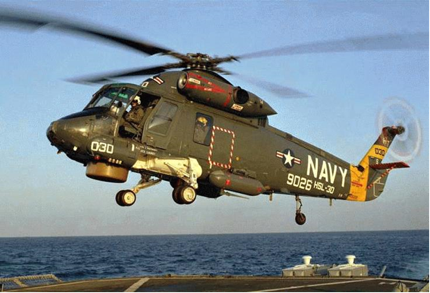
This picture shows one of the six helicopters Jim flew in the Navy
He ended with a poem. A few of the verses:
I liked standing on the bridge wing at sunrise with salt spray in my face and clean ocean winds whipping in from the four quarters of the globe - - the ship beneath me feeling like a living thing as her engines drove her swiftly through the sea.
The work was hard and dangerous; the going rough at times; the parting from loved ones painful, but the companionship of robust Navy laughter, the "all for one and one for all" philosophy of the sea was ever present.
And I liked the sight of space-age equipment manned by youngsters clad in dungarees and sound-powered phones that their grandfathers would still recognize.
In years to come, when sailors are home from the sea, they will still remember with fondness and respect the ocean in all its moods - the impossible shimmering mirror calm and the storm-tossed green water surging over the bow. And then there will come again a faint whiff of jet exhaust, a faint echo of engine and rudder orders, a vision of the bright bunting of signal flags snapping at the yardarm, a refrain of hearty laughter in the wardroom and chief's quarters and mess decks.
Gone ashore for good they will grow wistful about their Navy days, when the seas belonged to them and a new port of call was ever over the horizon.
Remembering this, they will stand taller and say, "I was a sailor once and I would do it again."