August is membership month. We are people of action. We recruit, explain, build, inspire, and help people understand the message of Rotary and what it means to be a Rotarian. We will be talking about membership this month but please take a moment and think about someone you know who may enjoy the benefits of helping other people here and around the world. Bryce has set up a fellowship happy hour with Christina Price for September. Please invite a friend to enjoy the fellowship, the food and to see her new facility and see what Rotary is about. Let's get the word out that "we are the inspiration"
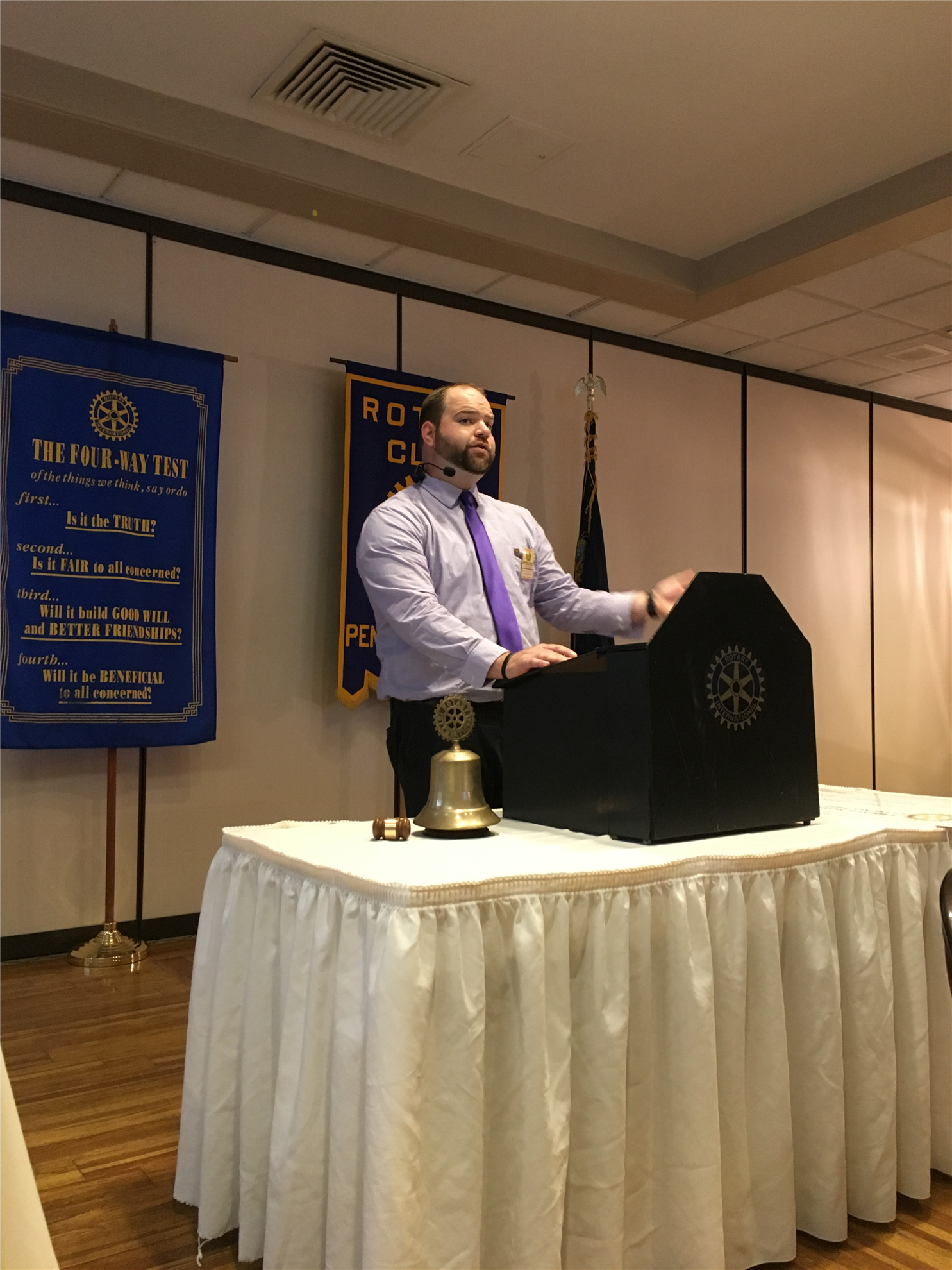
Morgan Scott, one of Emmaus Rotary Club's newest members presented his personal and professional life to us in a way that captured everyone's attention. You never really know someone's story until they are asked to share it. The next time you hear about the "Friends of Owen Thomas Tournament" remember Morgan and his family are honoring his brother who died prematurely of CTE (Chronic Traumatic Encephalopathy). They are raising money for research and education. Check out his full classification talk on youtube!!!
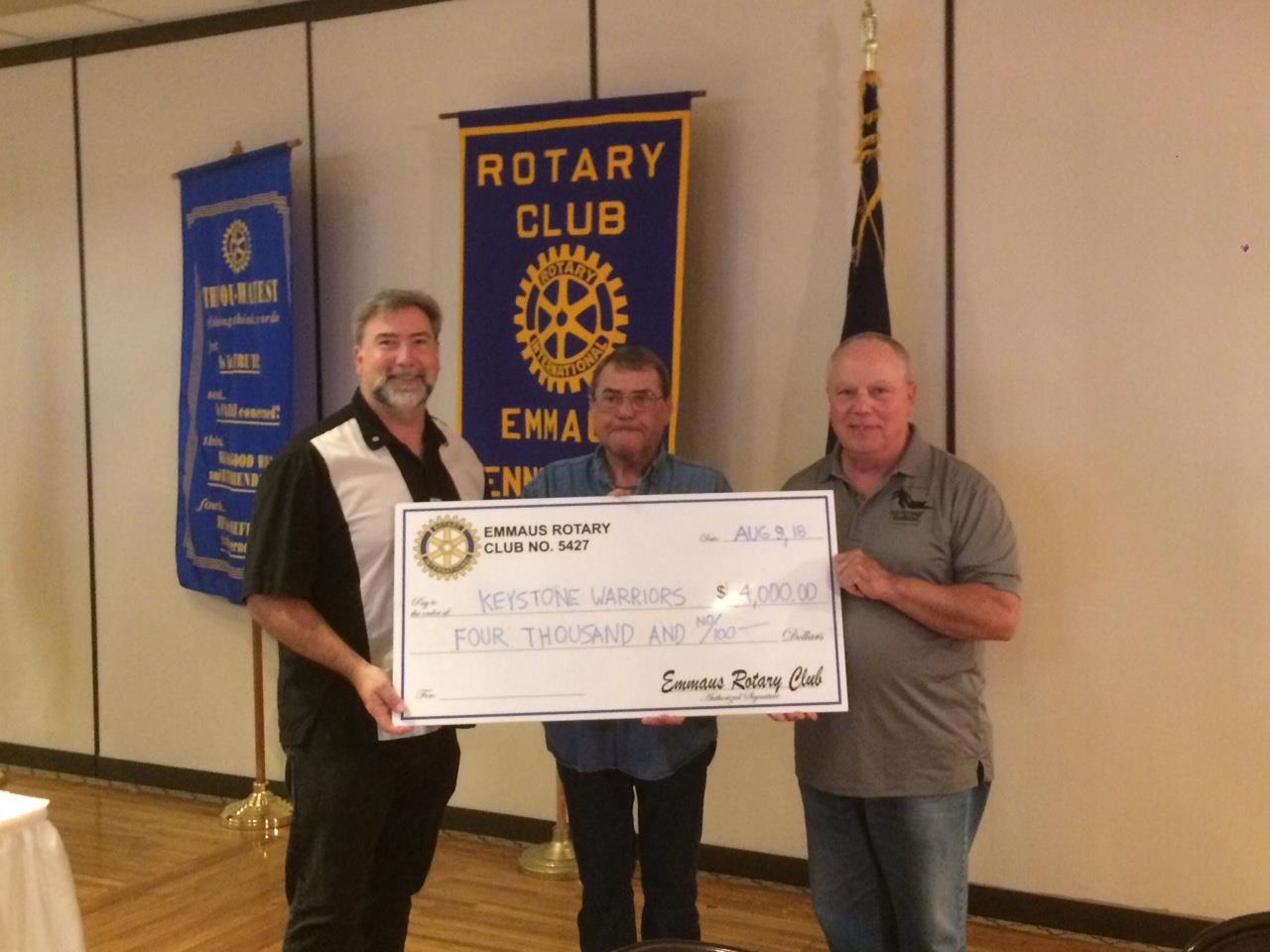
Chairperson for the Motorcycle Poker Run Mark Erle presented a donation of $4000 to Paul Spurgin and Michael Doratacci who represented the Keystone Warriors, a local veterans' support group. Spurgin, the founder of Keystone Warriors, spoke briefly to thank the Emmaus Rotary and to relate that this donation meant their group will be able to go forward to fulfill a 10-year- wish. Keystone Warriors will be opening transitional housing for those returning from military deployment. They seek to establish a community in a building with 2 and 3 bedroom apartments. Priority attention will be given to vets with families and vets completing higher education work.
Erle thanked Emmaus Rotary for getting behind this inaugural event. He reported that the steering committee met to evaluate the project and has decided to hold a second Motorcycle Run, probably in June 2019, and the profits will go to another designated group working in our area.
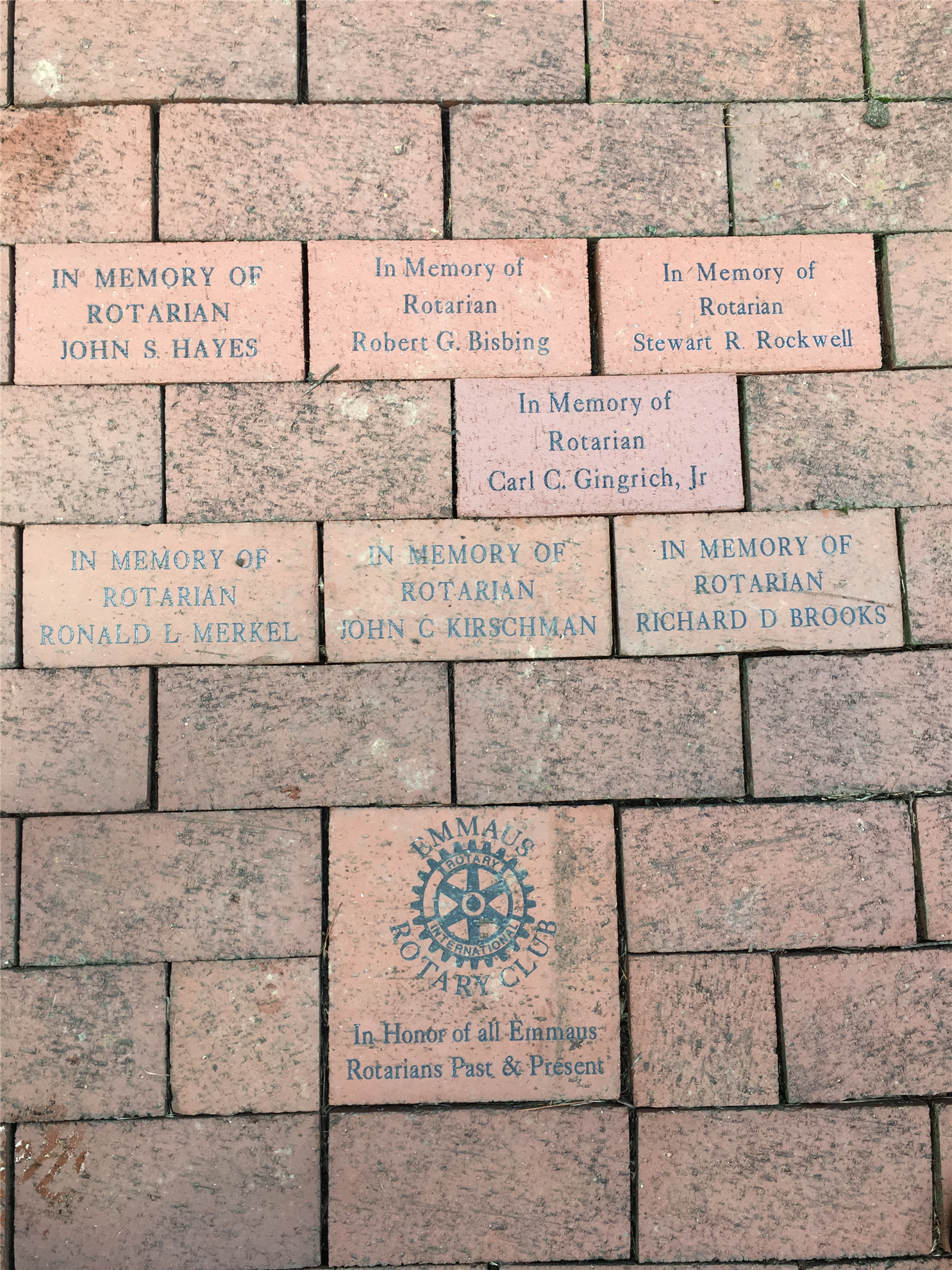
Three generations of his Family and fellow Rotarians gathered on Thursday, August 9, 2018 at the Emmaus Remembrance Garden to honor Carl Gingrich by laying a brick inscribed with his name. His brick was placed near his cohorts or "posse" of club members he knew well and worked on projects with them.
Several Rotarians spoke movingly but the final tribute was offered by Carl's four year old Grandson Zeke who had told his Mother earlier in the morning that his Grandfather was the "best grown-up ever" who taught them to be good people.
We are excited to announce our next fellowship event!
It will be on Thursday, September 27th from 4:30 pm to 6:30 pm at the new Legend Personal Care & Memory Care center on Lower Macungie Road. There will be fantastic food and drinks, as well as a tour of the new facility.
This is a free event for all Rotary members and friends of Rotary. Spread the good news!
Keep an eye out for the save the date and more details to come!!!
Don Blose has secured 25 tickets to the Iron Pigs game on Friday evening August 24th. Things are heating up for play offs and this is the last Friday night game before playoffs. Ticket price is $11, for the section behind third base. These are not reserved tickets. However they include $2 for food for the evening. Don has 8 tickets sold already and as always first come first served. Enjoy an evening of fun, fireworks and baseball with your Rotarian friends.
The 11th Annual Emmaus Rotary Golf Tournament will be held
on Monday, October 15, 2018
at Brookside Country Club.
Emmaus Rotarians-- bring your raffle tickets, stubs and money to this Thursday's regular breakfast meeting.
And try to let everyone you sold raffle tickets to know the drawing will now be held on October 15.
.
REGISTER TO PLAY ON October 15th NOW!!
WWW.ERCGOLF.COM
2018 Golf Committee
Co-Chairmen-Steve Gould, John Zayaitz
Committee Members - Mario Cozzubbo-Treasurer, Bob Rust, Don Blose, Mike Lahanas, Joe Pugliese, Rick Zayaitz, Bryce Ruggieri, Rory King, Eric Loch Lisa Spradlin, Morgan Thomas, John Chisca
The conversation has begun on the health model for preventing violence called Cure Violence. Of the eleven Emmaus Rotarians who expressed interest in discussing the interview with Gary Slutkin printed in the August 2018 Rotarian magazine, six met last Monday morning, August 20th to explore ways to educate ourselves about this promising approach and to determine if it might be useful here in the Lehigh Vally.
Sue Straeter-Doviak is tracking down the availability of an award-winning documentary we may use to educate ourselves.
‘The Interrupters’ is a critically acclaimed 2011 documentary telling the story of three Cure Violence workers who try to protect their Chicago communities from the violence they once employed. It examines a year in which Chicago drew national headlines for violence and murder that plagued the city. The Interrupters shows the Cure Volence Health model in action. Shot over the course of a year out of Kartemquin Films, the film follows Ameena Mathews, Cobe Williams and Eddie Bocanegra as they go about their work, and while doing so reveals their own inspired journeys of hope and redemption.
Lexa Shallcross will be contacting fellow Rotarian, Peace Scholar and Philadelphia police officer D F Pace, who spoke to the Emmaus Rotary last winter, for an introduction to the Philadelphia group Cease Fire which is using this model.
Jim Palmquist has been resourcing the group. He prepared a precise of Steven Pinker's research on the constellations of violence from his book Enlightenment Now which backs up the Cure Violence model of prevention and interruption. That summary is available below this article.
Rotarians at this first meeting were Ceil Birdell, Bill Erdman, Bob Haley, Sue Straeter-Dovak, Lexa Shallcross and Jim Pallmquist.
Join the conversation.
Enlightenment Now – The Case for Reason, Science, Humanism and Progress, by Steven Pinker, 2018.
Extract on violence reduction starting on page 172:
Violent crime is a solvable problem. We may never get the homicide rate for the world down to the levels of Kuwait (04 per 100,000 per year), Iceland (03) or Singapore (02), let alone all the way to 0. But in 2014, Eisner, in consultation with the World Health Organization, proposed a goal of reducing the rate of global homicide by 50% within thirty years. The aspiration is not Utopian but practical, based on two facts about the statistics of homicide. 171 The first is that the distribution of homicide is highly skewed at every level of granularity. The homicide rates of the most dangerous countries are several hundred times those of the safest, including Honduras (904 homicides per 100,000 per year), Venezuela (53.7), El Salvador (41.2), Jamaica (39-31 Lesotho (38), and South Africa (31)* Half of the world’s homicides are committed in just twenty-three countries containing about a tenth of humanity’ and a quarter are committed in just four: Brazil (25.2), Colombia (25.9), Mexico (12-9), and Venezuela. …The lopsidedness continues down the fractal scale. Within a country, most of the homicides cluster in a few cities, such as Caracas (120 per 100,000) and San Pedro Sula (in Honduras, 187). Within cities, the homicides cluster in a few neighborhoods; within neighborhoods, they cluster in a few blocks; and within blocks, many are carried out by a few individuals.’/ In my hometown of Boston 70 percent of the shootings take place in 5 percent of the city, and half the shootings were perpetrated by one percent of the youths. 172 The other inspiration for the 50-30 goal is evident from figure 12-2: high rates of homicide can be brought down quickly. The most murderous affluent democracy the United States, saw its homicide rate plunge by almost half in nine years; New York City s decline during that time was even steeper, around 75 percent. Countries that are still more famous for their violence have also enjoyed steep declines, including Russia (from 19 per 100,000 in 2004 to 9.2 in 2012), South Africa (from 60.0 in 1995 to 31.2 in 2012), and Colombia (from 79.3 in 1991 to 25.9 in 2015).20 Among the eighty-eight countries with reliable data, sixty-seven seen a decline in the last fifteen years.21 The unlucky ones (mostly in Latin America) have been ravaged by terrible increases, but even there, when leaders of cities and regions set their mind to reducing the bloodshed, they often succeed.2* Figure 12-1 shows that Mexico, after suffering a reversal from 2007 to 2011 (entirely attributable to organized crime), enjoyed a reversal of the reversal by 2014, including an almost 90 percent drop from 2010 to 2012 in notorious Juarez…….
The math is straightforward: a 50 percent reduction in thirty years is not just practicable but almost conservative.
The lopsided skew of violent crime also points a flashing red arrow at the best way to reduce it. Forget root causes. Stay close to the symptoms—the neighborhoods and individuals responsible for the biggest wedges of violence—and chip away at the incentives and opportunities that drive them. 173
Here is Eisner’s one-sentence summary of how to halve the homicide rate within three decades: “An effective rule of law, based on legitimate law enforcement, victim protection, swift and fair adjudication, moderate punishment, and humane prisons is critical to sustainable reductions in lethal violence”. Adjectives effective, legitimate, swift, fair, moderate and humane differentiate his advice from the get-tough-on-crime rhetoric-c favored by right-wing politicians. The reasons were explained by Cesare Beccaria two hundred and fifty years ago. While the threat of ever harsher punishments is both cheap and emotionally satisfying, it’s not particularly effective, because scofflaws just treat them like rare accidents-horrible, yes, but a risk that comes with the job. Punishments that are predictable, even if less draconian, are likelier to be factored into day-to-day choices. 174
Recent reviews of what does and doesn’t work in crime prevention back up Eisner’s advisory/ particularly a massive meta-analysis by the sociologists Thomas Abt and Christopher Winship of 2,300 studies evaluating just about every policy/plan, program, project, initiative, intervention, nostrum, and gimmick that has been tried in recent decades. They concluded that the single most effective tactic for reducing violent crime is focused deterrence, k “laser-like focus” must first be directed on the neighborhoods where crime is rampant or even just starting to creep up, the “hot spots” identified by data gathered in real time. It must be beamed at the individuals and gangs who are picking on victims or roaring for a fight. And it must deliver a simple and concrete message about the behavior that is expected of them, like “Stop shooting and we will help you, keep shooting and we will put you in prison.” Getting the message through, and then enforcing it, depends on the cooperation of other members of the community—the store owners, preachers, coaches, probation officers, and relatives. 174
Also provably effective is cognitive behavioral therapy. This has nothing to do with psychoanalyzing an offender’s childhood conflicts or propping his eyelids open while he retches to violent film clips like in A Clockwork Orange. It is a set of protocols designed to override the habits of thought and behavior that lead to criminal acts. Troublemakers are impulsive: they seize on sudden opportunities to steal or vandalize, and lash out at people who cross them, heedless of the long-term consequences. These temptations can be counteracted with therapies that teach strategies of self-control. Troublemakers also have narcissistic and sociopathic thought patterns, such as that they are always in the right, that they are entitled to universal deference, that disagreements are personal insults, and that other people have no feelings or interests. Though they cannot be “cured” of these delusions, they can be trained to recognize and counteract them.* This swaggering mindset is amplified in a culture of honor, and it can be deconstructed in therapies of anger management and social-skills training as part of counseling for at-risk youth programs to prevent recidivism. 175
….aggressive drug enforcement yields little anti-drug benefits and generally increases violence,” while “drug courts and treatment have a long history of effectiveness.” 176